(Last review on Apr 21st, 2026)
LEM covers on-demand repair and maintenance of standardized laboratory equipment. Pilot-scale systems, experimental designs, and outdoor equipment are generally out of scope. Experimental designs include prototypes or equipment assembled without manufacturer-provided maintenance documentation (e.g., user manuals, maintenance manuals, or engineering drawings). For such equipment, labs are responsible for defining the maintenance strategy and allocating the necessary budget. Custodians are encouraged to consult LEM at lem@kaust.edu.sa regarding maintenance of such equipment prior to submitting a request.
Maintenance services are provided for laboratory equipment where original configurations are preserved, subassemblies are located on or can be transported to the KAUST campus, and manufacturer maintenance documentation is available.KAUST owns all research equipment purchased using University funds. Each piece of equipment owned by KAUST must be allocated to a specific Custodian. For research assets, custodianship will be assigned by ASEPC and is generally as follows:
LEM will assign custodianship of taggable equipment following the criteria above, as well as the funding source.
Custodians are responsible for the operation, maintenance, safeguarding, monitoring, and end-use compliance of their assigned equipment, including retention of data to support and demonstrate conformance with these guidelines. Any equipment loan, transfer, disposal, or relocation must be accompanied by the relevant forms submitted to LEM. These responsibilities also apply to any research asset or taggable equipment that is delegated.
Research assets are KAUST fixed assets under the Vice-President for Research Officer (VPR-O), which include the Research Platforms, Core Labs, Centers of Excellence, and individual PI labs. Research assets must meet the capitalization threshold of USD 50,000 as defined by Finance Asset Management (FAM) in the Fixed Asset Management Procedure. For assets acquired before 1st July 2023, the previous capitalization threshold of USD 20,000 applies.
To ensure KAUST's objectives continue to be met, Custodians must review their equipment replacement plans annually and provide a multi-year replacement estimate to allow for long-term operational and capital planning. Items that meet the capitalization threshold of USD 50,000 are subject to approval by ASEPC. Funding proposal deadlines and CAPEX guidelines are available at asep.kaust.edu.sa. Custodians should update their replacement plans using the Asset Replacement Planning application.
Acquisition of research equipment is governed by Procurement procedures. Custodians are responsible for submitting the purchase requisitions. Purchases of research equipment that meet the capitalization threshold of USD 50,000 are subject to approval by ASEPC. When raising a purchase request, the product category ‘FA’ must be selected for any taggable line item. Proper category selection will enable the system to automatically generate tag numbers, streamlining the tagging process when goods are received.
In exceptional circumstances, Custodians may be authorized by Procurement to acquire taggable equipment through P-cards, subject to prior assessment and approval on a case-by-case basis.
Depending on the agreement between Custodians and LEM, the maintenance costs arising from an instrument's normal and proper use may be fully, partially, or not covered by LEM. Custodians are encouraged to consult with LEM about the coverage of maintenance costs before submitting a funding proposal or acquiring non-capital equipment.
A list of LEM preferred vendors is available in the Maintenance Services section.
All research assets that are built, acquired, or upgraded must be recorded in the Fixed Asset Register (FAR). Once an asset is commissioned, tested, or put into service—fully or partially—the Custodian must initiate a capitalization request by submitting the required tagging and capitalization information to LEM within 15 working days, or before the end of the current fiscal year, whichever occurs first.
LEM, in coordination with Finance Asset Management (FAM), maintains a monthly Asset Under Construction (AUC) report to track ongoing projects. Custodians are responsible for providing accurate project status updates, supporting documents, and expected in-service dates within five working days of a request from LEM, in line with FAM reporting requirements.
All research equipment that meets the capitalization threshold or is attractive to KAUST must be tagged after being commissioned, tested, or put into service-fully or partially. Tagging applies to items that meet one or more of the following criteria:
Custodians are responsible for submitting the tagging requests through Asset Management services once the equipment is ready for use.
Note: Tagging does not apply to consumables, run-to-failure items, software, or items with a useful life of less than one year. IT is responsible for tagging computers and corporate software.
End-User Certificates (EUCs) are required by the country of origin for certain items to certify that they will not be used for military or non-peaceful applications, dual-use research, or resold to restricted countries. LEM has the delegation from the VPR to sign EUCs within the LEM scope, which includes the following items:
All controlled items must be KAUST-owned and located in the Kingdom. The issuance of End-User Certificates for research assets and taggable equipment is part of the customs clearance process and shall be managed by Procurement and LEM.
Custodians (end-users) shall not sign export control documents on behalf of KAUST or directly manage the issuance of export control certificates.
Custodians shall provide detailed information about the end-use to LEM as requested by the Vendor or the authority of the issuing country. An internal End-Use statement form will be signed by the Custodian and will be linked to the equipment system records for future traceability.
Custodians are responsible for budgeting and allocating operational costs of their assigned pieces of equipment throughout their life cycles.
LEM encourages Custodians to use Infinity as the preferred lab management system to manage the utilization of their critical equipment, to provide chargeable services, or to track publications related to their equipment.
Infinity is managed and maintained by Shared Services, under Research Operations. For further, details please contact Shared.Services@KAUST.EDU.SA
Custodians are responsible for safeguarding and accounting for the equipment assigned to them. To comply with Finance Asset Management (FAM) directives, LEM will engage with Custodians to perform inventory as follows:
Custodians are encouraged to perform their own ad hoc equipment inventories, for which LEM can provide system records and relevant information, in addition to updating the entries to reflect the updated findings. Physical inventory counts, in this case, must be conducted by lab personnel. This also includes on-demand inventory counts by Internal Audit.
Custodians are responsible for reporting potential missing equipment to LEM and Security teams. Upon request, LEM can provide system records and relevant information to support the initial investigation by the Custodians. If the items cannot be located, Custodians must report the incident to KAUST Security for further investigation and documentation.
Once the missing property report is completed, LEM will update the system records to reflect the property as missing. The records will remain assigned to the related Custodian until a disposal process is initiated and approved. The report issued will serve as a waiver for the disposal, and Custodians may be responsible for recovering costs.
Equipment may be located outside KAUST for field research, research collaborations, or maintenance purposes. In any of such scenarios, Custodians are responsible for obtaining proper documentation and approval before the facts.
For equipment used in field research, where possession remains with the Custodian or delegated KAUST personnel, a gate pass is required to document the temporary location outside KAUST. Custodians are encouraged to establish internal processes to ensure safeguarding and liabilities during such temporary use, limited to the KAUST research community.
When equipment needs to be sent outside KAUST for research collaborations or maintenance, an approved binding agreement or service purchase order is required. To obtain the latest agreement template, please contact Material Transfer Agreement mta@KAUST.EDU.SA.
After securing the documentation, Custodians need to submit an Export Shipping Request via https://procurementforms.kaust.edu.sa/ for the issuance of shipping documents, including pictures, duration of transfer, and identification of tags, followed by the approval of a gate pass by the Security team.
Once the items return to KAUST, Custodians must notify Export Logistics export.logistics@KAUST.EDU.SA for clearance purposes. Failing to comply with the equipment return characterizes missing property, and Custodians may be responsible for recovering costs.
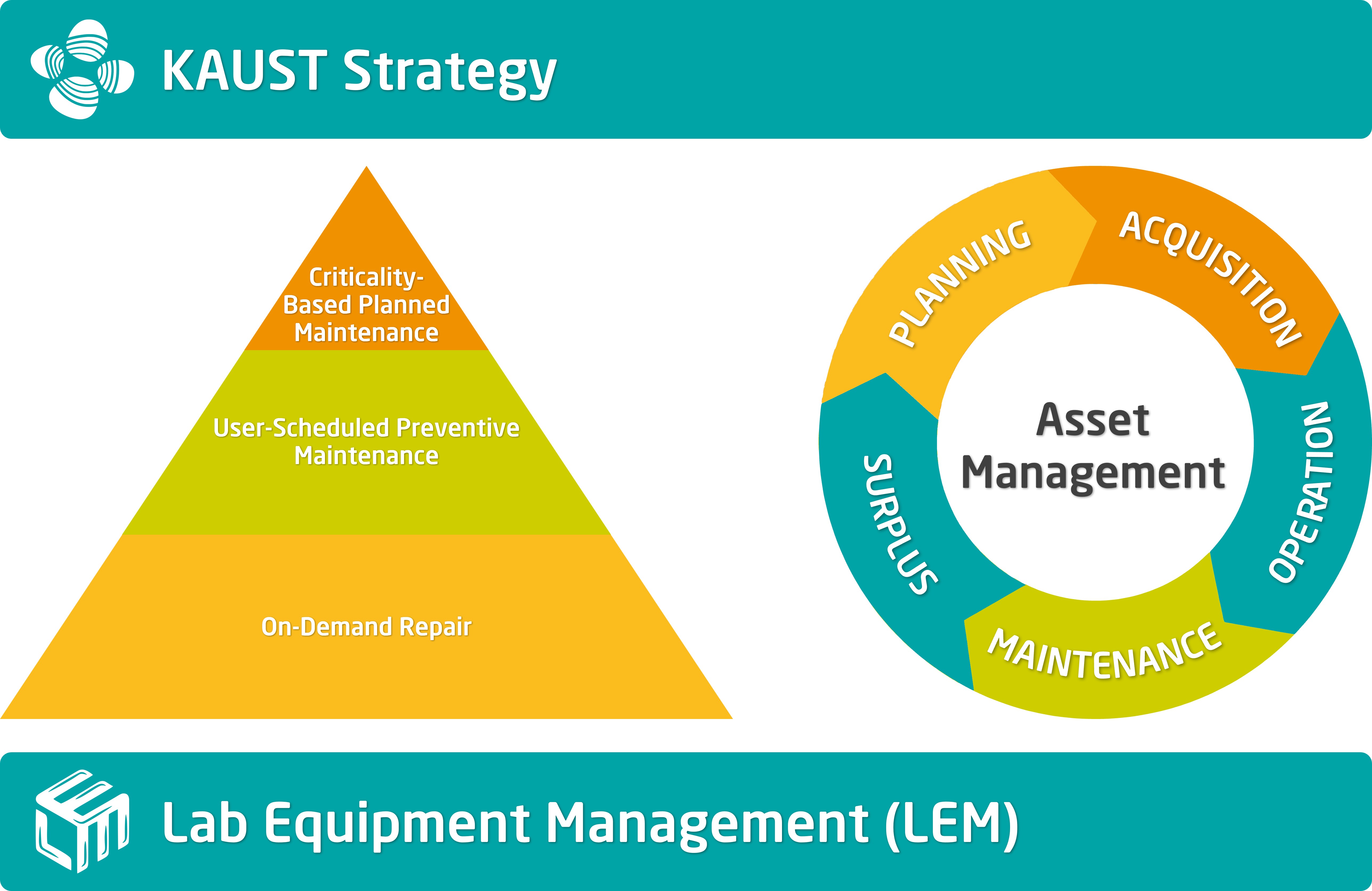
Custodians are responsible for maintaining their assigned pieces of equipment throughout their life cycles. Depending on the criticality and impact of the equipment on KAUST objectives, one or more of the following maintenance approaches apply:
Custodians are responsible for retaining records of maintenance services in accordance with the agreed-upon maintenance strategy.
Depending on the agreement between Custodians and LEM, the maintenance costs arising from an instrument's normal and proper use may be fully, partially, or not covered by LEM. Custodians are encouraged to consult with LEM about the coverage of maintenance costs before submitting a funding proposal or acquiring non-capital equipment.
A list of LEM preferred vendors is available in the Maintenance Services section.
Equipment may be loaned to a Borrower for temporary use. In such cases, a request must be submitted to LEM, and the transaction must be approved by the Custodian and the Borrower. LEM will update the system records to reflect the temporary location, along with the expected return date. The Borrower must return the equipment in good working condition, considering normal wear and tear.
The Borrower is responsible for the operational and maintenance routines related to the loaned equipment before its return and must not transfer it to a third party under any circumstances.
The Custodian reserves the right to recall the equipment at any time without incurring any costs.
Equipment may be transferred to another Custodian for permanent use. In such cases, a request must be submitted to LEM, and the transaction must be approved by the Heads of Units of existing and new Custodians. LEM will update the system records to reflect the permanent location. Transfer of research assets (capital equipment) must be approved by ASEPC before initiating the transfer process.
The new Custodian will be responsible for the operational and maintenance routines related to the assigned equipment and all applicable duties after the reallocation.
Costs may be incurred for the physical movement of research equipment, depending on the resources needed for the transfer:
An impaired asset is an asset that has a market price less than the carrying value listed on the KAUST balance sheet. This difference represents a financial loss and may arise from incidents, obsolescence, physical damage, or poor performance.
The Asset Custodian is responsible for reporting impairments to Finance Asset Management (FAM) and responding promptly to the FAM Impairment Questionnaire upon request.
Effective September 15, 2024, the disposal process at KAUST was updated by Finance Asset Management (FAM), and a workflow applicable to all disposals was established. To maximize the return on the disposal of research equipment, the sequence begins with offering the equipment under the Surplus Program (if the equipment is in working condition), followed by tentative Sales, collaborations through Social Responsibility, and finally, scrapping unclaimed equipment via Waste Management.
To be cataloged in the Surplus Program, the equipment must be in working condition, and all accessories, software, and licenses must be available. The Custodian is responsible for reporting missing parts that may compromise the workability of the disposed equipment and impair its full use after reallocation.
The reallocation of research assets (capital equipment) is subject to approval by ASPEC, while the reallocation of non-capital equipment is subject to approval by an internal LEM Committee.
Custodians must notify LEM as early as possible of their upcoming departure. If the departure occurs under confidential circumstances, the Custodian managers must disclose this to LEM and engage with LEM to establish a plan for departure clearance.
Custodians are responsible for:
All discrepancies will be documented and resolved by the Custodian. Failing to comply with the required steps may result in the non-issuance of departure clearance. If the Custodian leaves KAUST before the departure clearance, the reporting manager assumes the clearance responsibilities.